


Milan Design Week, 2026: A round-up
Last month, Francisco visited Milan Design Week, the world’s largest annual design event and the place where the global conversation about how we live with materials happens in public.
Milan Design Week is really two events under one umbrella. Salone del Mobile.Milano is the official trade fair at Rho Fiera, with more than 1,900 exhibitors across 169,000 square metres. Around it, the Fuorisalone (literally “outside the fair”) turns the city itself into a stage, with hundreds of installations, brand activations and exhibitions across districts like Brera, Tortona, 5Vie and Isola. Together, they make up one of the most important weeks in the global design calendar.
The scale takes some adjustment. Salone alone fills more than twenty halls. Construction-trade shows we know well (including ones we’ve exhibited at).
Two days, it turns out, is not enough.
From specification to lifestyle
The most striking thing about Milan isn’t the size. It’s the shift it represents.
Trade shows in our industry have traditionally been about specification: industrial stands, technical data, samples to handle. Milan does the opposite. Stands are designed as fully staged homes: kitchens, lounges, dressing rooms, gardens. Materials aren’t presented as products to specify. They’re shown being lived with.
That matters. Architects, developers and end-clients want to see materials in context, not isolation. They want to know how a surface feels at home, how it works alongside other elements, how it reads as part of a life. It’s a shift we’ve felt in our own client work for some time, and Milan put it into focus.
Terrazzo, reimagined
If one material was having a moment, it was terrazzo.
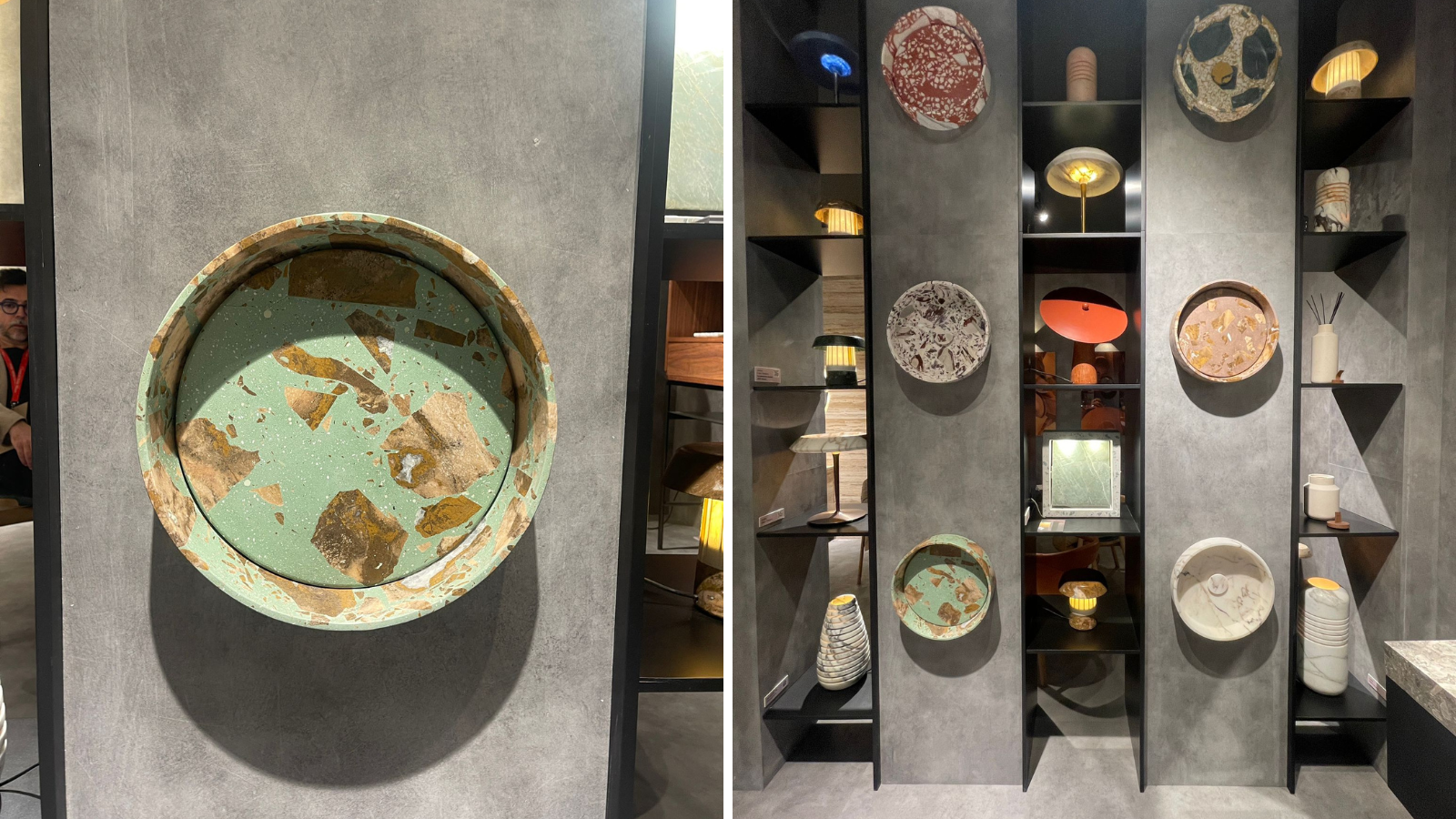
It appeared everywhere, often in unexpected forms. Sculptural washbasins displayed like museum pieces, in deep reds and whites, dramatic violet veining, mint greens with amber chips. Pool tables built from solid terrazzo slabs. Bar tops, side tables, hexagonal stools.
One company had organised its range under the periodic table, naming colours after chemical elements. A quiet reminder that terrazzo is, at its core, a celebration of mineral matter.
We’ve worked with terrazzo since the beginning, and seeing it treated as an art object as well as flooring was a useful reminder of its range. The same material can be a quiet floor in a museum or a sculptural statement in a private home.
Stone in unexpected places
Bagnara had built a fully functional bowling lane out of pale veined marble. Pins and balls included. Whether they actually produce these or whether it was Milan theatre, the point landed: stone, played with rather than just specified.
A pink Estremoz marble shower elsewhere caught Francisco’s attention for a different reason. Estremoz is a Portuguese marble we work with, quarried in the Alentejo, with characteristic blue-grey veining running through warm cream and rose tones.
It belongs to the same heritage tradition as the Candoglia marble that clads the Duomo di Milano just down the road from the fair. Different stones, but part of the same European story of stone shaping historic architecture.
The steel kitchen question
A clear trend: stainless steel kitchen units are increasingly common in residential settings. Several stands featured large brushed steel islands, integrated sinks, and restaurant-grade hobs. The bones of a professional kitchen, staged for everyday life.
It opens an obvious question for anyone planning a renovation: what flooring belongs with it? Tile reads as too clinical. Timber softens the look in a way that can feel inconsistent. Polished concrete and terrazzo, by contrast, extend the same language: hard-wearing, honest, made for serious use. They give the steel a foundation rather than fighting against it.
A familiar sight
Walking through the centre, Francisco stopped in at the END flagship store overlooking the Duomo. It’s a project we contributed to: SIBEXTREME AF FLOW floors and SIBDEKODUR terrazzo precast furniture and walls, designed by Brinkworth and installed by Pavimenti Speciali Srl.
A nice moment of full circle. Among everything we’d been seeing (staged homes, sculptural surfaces, inventive stands), here was our own work, in one of Milan’s busiest retail addresses, doing its job.
Smaller observations
A few smaller things stood out. The most memorable stands weren’t the most lavish. They were the ones that felt most like a place. Brands are increasingly thinking about materials as part of a complete sensory experience: light, planting, scent, sound. Atmosphere is doing the heavy lifting here.
We also met several Portuguese companies showing in Milan and had encouraging conversations with prospective clients planning private homes. A reminder that Milan isn’t only about the spectacle. Real projects start in chance moments like these.
“Be The Project”
This year’s Milan Design Week ran under the theme “Be the project”: design as a responsible, evolving process, not just a finished object. Materials sit at the heart of that idea, and it’s at the core of what we’ve been doing at SIB for the past 50+ years.
We’re committed to responsible development that respects our environment today without compromising tomorrow. From renewable energy to locally sourced materials, sustainability guides every decision we make; and it’s how we’ve always worked.
Milan Design Week, in short
Milan is a useful corrective. It’s easy in our industry to think about flooring in technical terms (coverage rates, cure times, performance ratings) and forget that for the people who live and work on these surfaces, the conversation is really about atmosphere, and how a space feels.
We came back with notebooks full of references and a renewed sense of where our materials sit: serious products that also have the design language to hold their own in the world’s most influential design fair.
Two days wasn’t enough. We’ll be back.
And of course, you can’t visit Milan without eating pizza. Thanks to Gino e Toto Sorbillo for the wood-fired deliciousness (plus Aperol Spritz!) and a moment to rest after thousands of steps.